The thread · c. 1533 – 2026
Thirteen stops
The magus as instrument Verified
The record
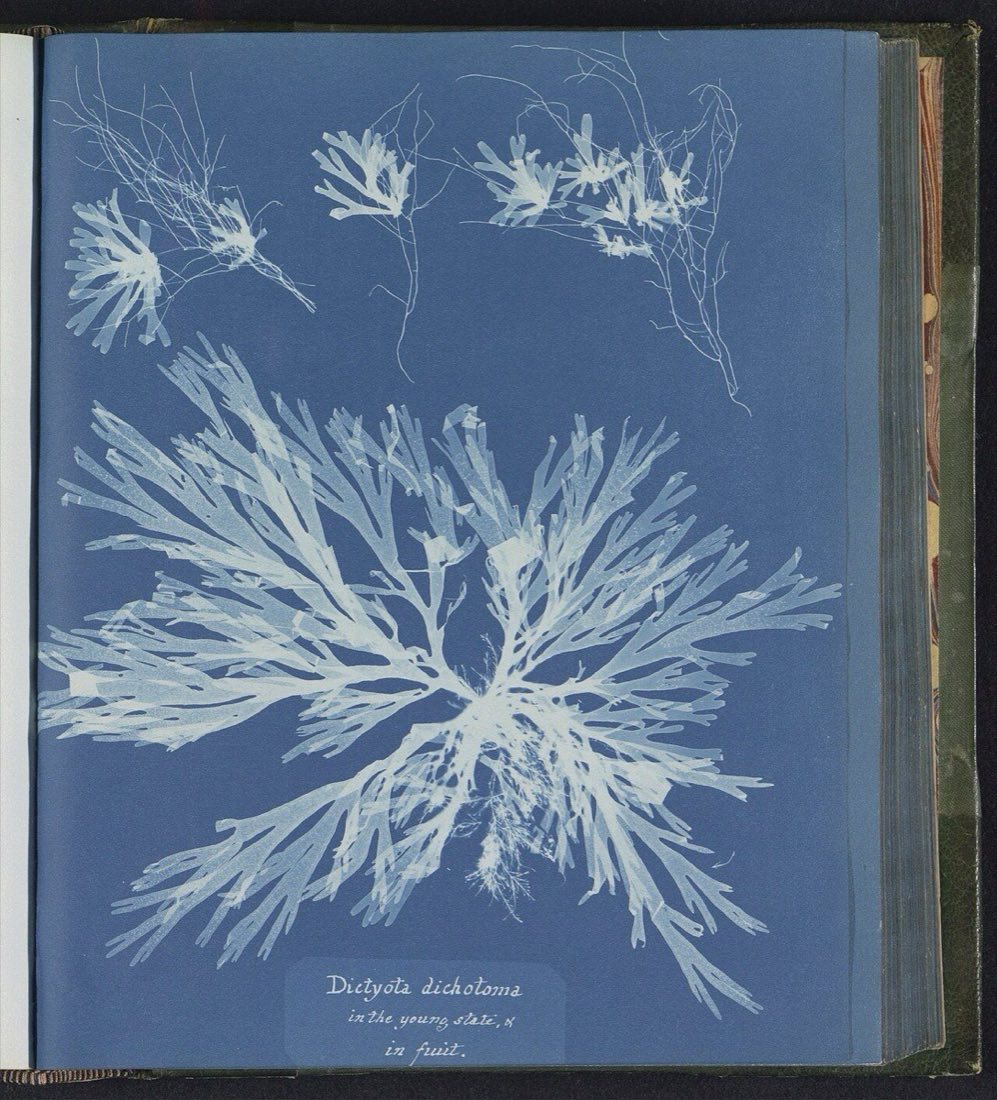
Heinrich Cornelius Agrippa’s Three Books of Occult Philosophy — the standard printed manual of Renaissance natural magicNatural magic — in Renaissance usage, the art of working with hidden but lawful powers in nature (magnetism was the standard example), as distinct from demonic conjuring. Closer to proto-experimental-science than to witchcraft. — circulates through educated Europe on the same presses that would carry the scientific revolution.
The reading
Agrippa’s doctrine holds that no operation works without the operator: the magus’s own disciplined and purified organization is a component of every experiment. The instrument does not act; the instrument-plus-the-prepared-human acts. Five centuries of the claim start here.
The first blinded trial is an operator test Verified
The record
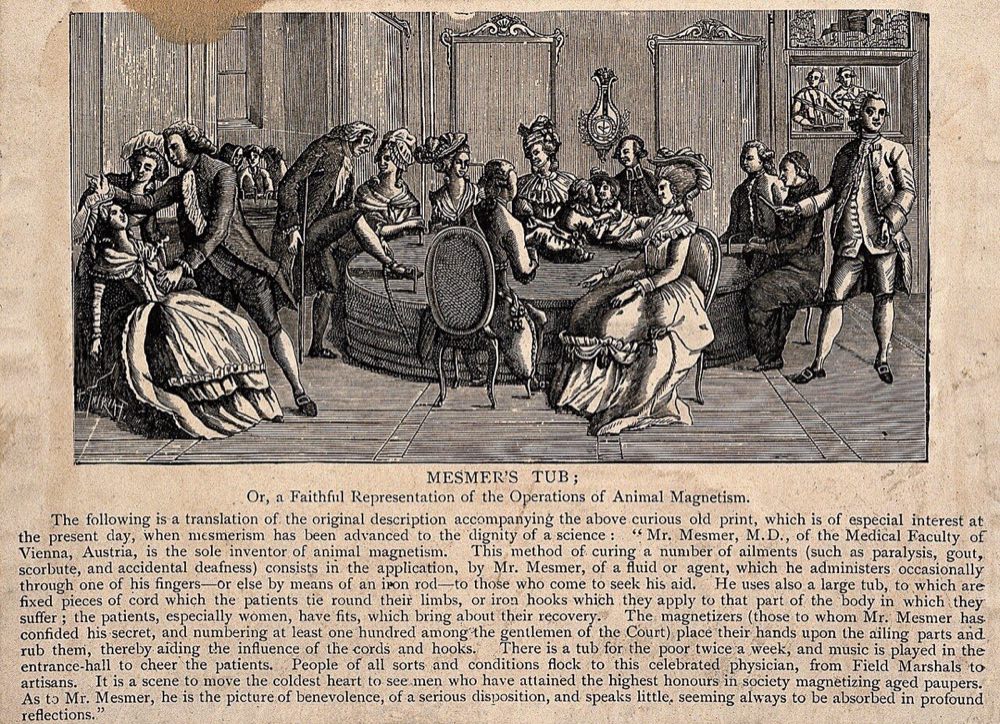
Franz Anton Mesmer’s healing salons run on real apparatus — the baquet, a tub of iron filings and magnetized water, with iron rods and a rope circuit linking the patients. Louis XVI appoints a royal commission: Benjamin Franklin, the chemist Lavoisier, and colleagues design what is now recognized as the first blinded placebo-controlled trialBlinded trial — an experiment in which the subject (and ideally the tester) does not know whether the real treatment or a sham is being applied, so that belief and expectation can be separated from physical effect. Still the backbone of drug testing today. in the history of science.
The reading
Mesmerism applied without the patient’s knowledge without the patient’s knowledge produced nothing; sham mesmerism in full view produced the full crisis. The first controlled experiment in science was, in form, a test of whether the operator is in the circuit. The two readings of its result — imagination; or a real rapport that blinding itself severs — parted company in 1784 and have never reunited.
Report of the commissioners (English trans. 1785); the secret report on the moral dangers went separately to the king.
The séance borrows the wire Verified
The record
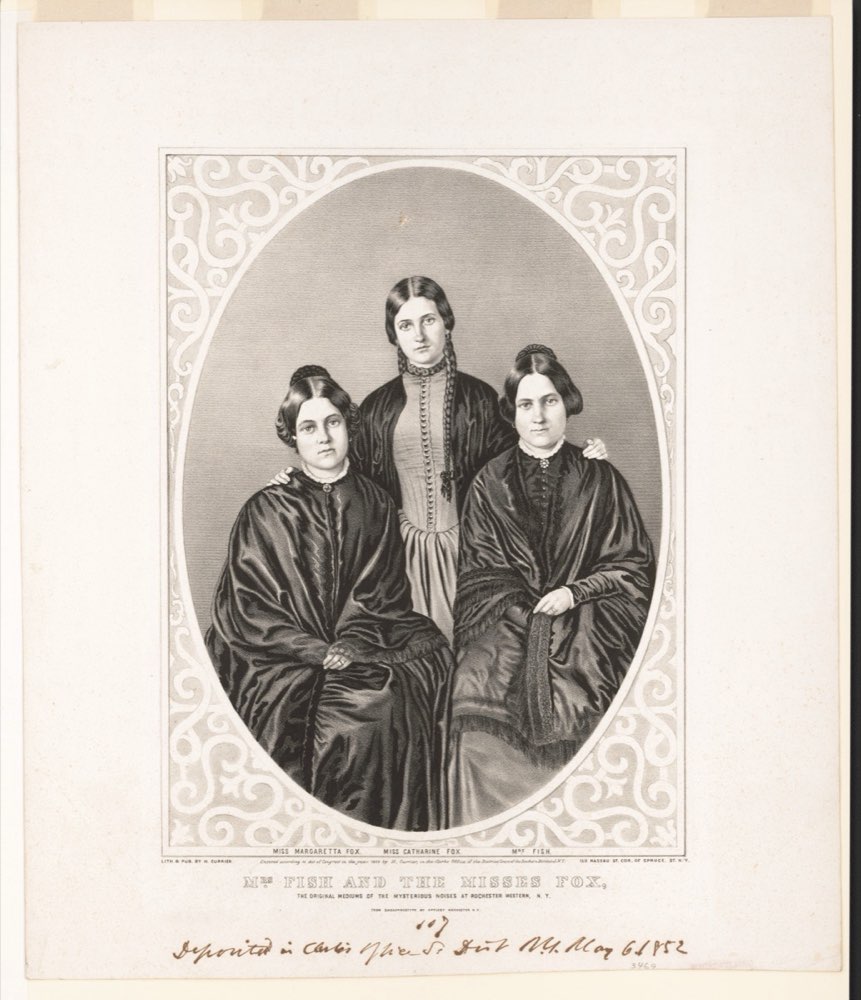
Morse’s Baltimore–Washington telegraphTelegraph — the first electric communication network (operational 1844): coded pulses over a wire, decoded at the far end. The first technology in history to separate a message from a physical carrier traveling with it. line opens in May 1844. Four years later, the Fox sisters’ coded rappings begin — and spiritualism names its practice after the machine: the spiritual telegraph, also the title of the movement’s first newspaper (New York, 1852–60).
The reading
The borrowed form concedes the thread’s claim: a telegraph needs an operator at the key, and the séance’s operator is the mediumMedium — in spiritualism, a person held to be constitutionally able to carry communication between the living and the dead. The word is the same one we now use for communication channels generally — that is not a coincidence; the histories tangle here., whose constitution — not the table, not the planchette — is the working part. Every physical investigation of spiritualism afterward is a version of the 1784 test.
A machine built by séance Disputed
The record
John Murray Spear — Universalist minister, abolitionist, prison reformer — assembles the New Motive Power on a hilltop in Lynn: copper, zinc, and magnets arranged to instructions received in trance from an Association of Electrizers (spirit Franklin presiding). A follower ritually births it. Observers record a slight oscillation of the metal balls; a disappointed spiritualist complains it “could not even turn a coffee mill.”
The reading
The episode is the thread at its maximum: engineering conducted as ritual, the machine conceived as offspring of its operators rather than product. The verdict badge is for its fate — the famous story that a mob destroyed the machine rests on one partisan tradition; the machine’s construction, animation ceremony, and failure are contemporaneously documented.
The motor that ran only for its maker Verified
The record
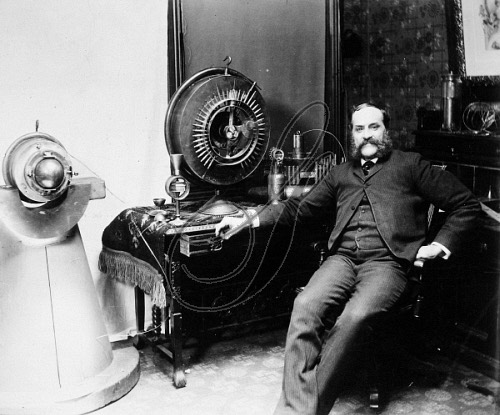
John Worrell Keely announces a motor driven by a force he never fully names — sympathetic vibration, ethericEtheric — in esoteric usage, a level of formative, life-bearing forces held to stand behind the physical. Not the same thing as the luminiferous ether of 19th-century physics, though the two ideas fed each other constantly in this period. force. For twenty-six years the demonstrations impress investors, engineers, and at least one Fellow of the Royal Society of Edinburgh. The machines run — when they run — only in his presence.
The reading
The theosophicalTheosophy — the esoteric movement founded around H. P. Blavatsky (Theosophical Society, 1875), which synthesized Western occultism with Indian metaphysics and gave the late 19th century most of its esoteric vocabulary. writers do not treat operator-dependence as Keely’s embarrassment. They elevate it to the explanation.
The doctrine states itself Verified
The reading
Blavatsky’s Secret Doctrine devotes a chapter, “The Coming Force,” to Keely — and writes the thread’s creed:
“…only in his hands and through himself.” H. P. Blavatsky, The Secret Doctrine, vol. I (1888), “The Coming Force,” on Keely’s discoveries
The same year, the theosophist Richard Harte adds the ethics that follow from the doctrine — a fully formed dual-use argument, seven decades before the phrase:
“…the world is not yet ready… It would be less disastrous to give dynamite cartridges to monkeys for playthings.” Richard Harte, introduction to “Keely’s Secrets,” Theosophical Siftings I:8 (1888)
Harte goes further: disclosed complete, such powers would fall to “the capitalists,” who “would be practically the absolute masters of the people.” The concentration-of-power critique is already there in 1888.
The floorboards come up Verified
The record
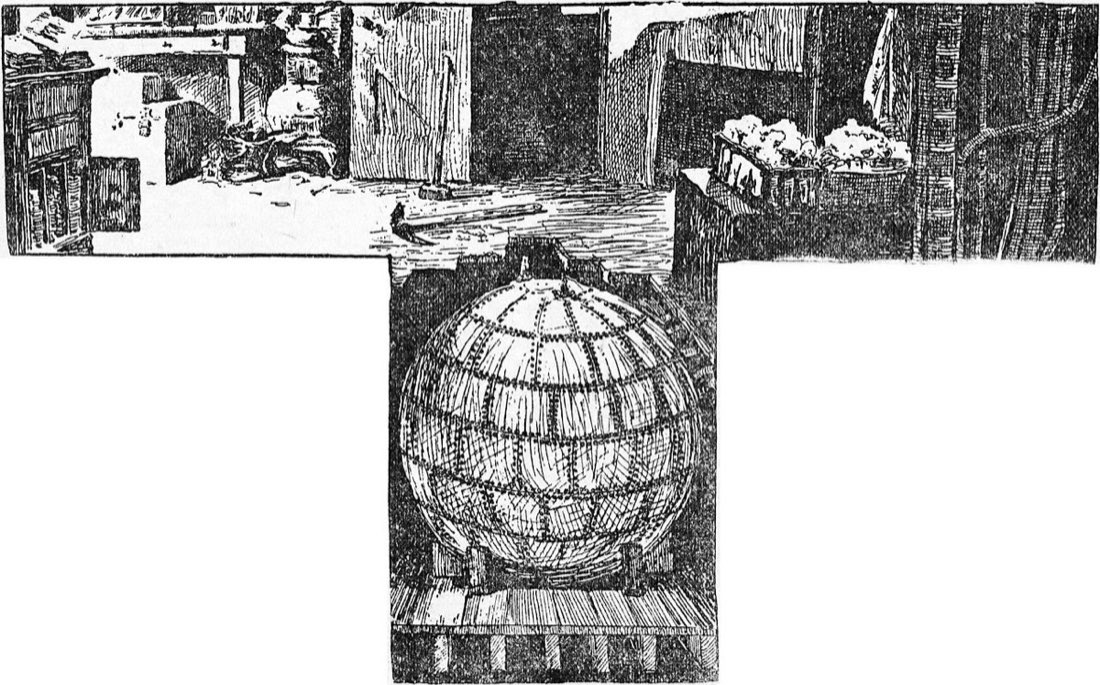
Keely dies in November 1898. Within weeks investigators — a consulting engineer, a University of Pennsylvania physicist, a psychologist — take up the workshop floor and find concealed brass tubing rated for high pressure, run through walls and solid beams, connectable to a three-ton steel sphere in the basement. The engineer, Carl Hering, signs his conclusion: Keely “intentionally and knowingly deceived the public when he held his exhibitions.”
The reading
And yet the exposure lands on a doctrine built, ten years earlier, to absorb it. The panel below sets the two accounts side by side — read both in full strength before deciding what kind of disagreement this is.
The investigation says
Hidden compressed-air infrastructure, photographed and attested in signed statements (1899). A dodged pressure-gauge challenge as early as 1884 (“I do not believe in pressure gauges, anyhow”). A stockholders’ committee finding of “deception and misrepresentation” in 1882. His own patron’s investigators concluded in 1895 that a “wire” in the demonstrations was an air pipe; Keely refused to let it be cut.
The fraud case explains the demonstrations.
The reception says
Blavatsky had written in 1888 — a decade before the tubes were found — that the force worked only in Keely’s hands and through himself; that “Keely’s ether” acted where “Smith’s or Brown’s” would remain barren; that the discovery had come “several thousand — or shall we say hundred thousand? — years too premature,” and that occultists had predicted the failure from the first.
The reception explains why no machine survived him.
The apparatus that excludes electricity Verified
The record
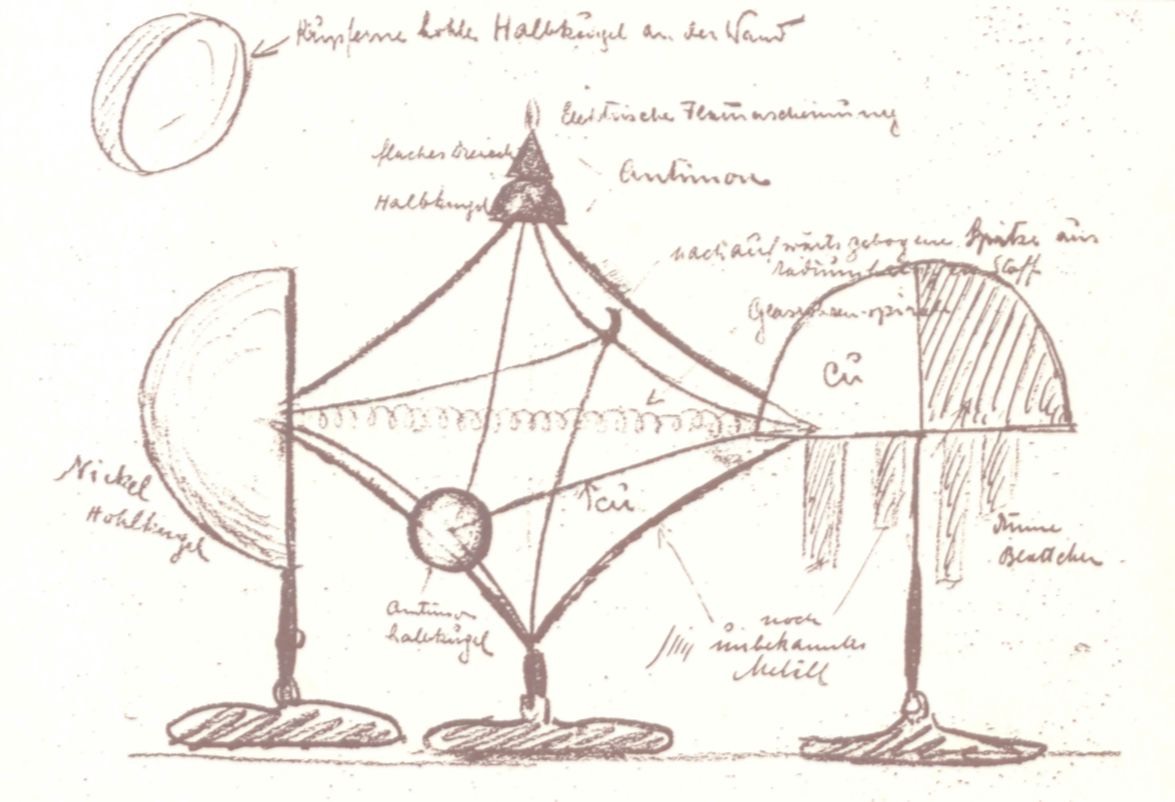
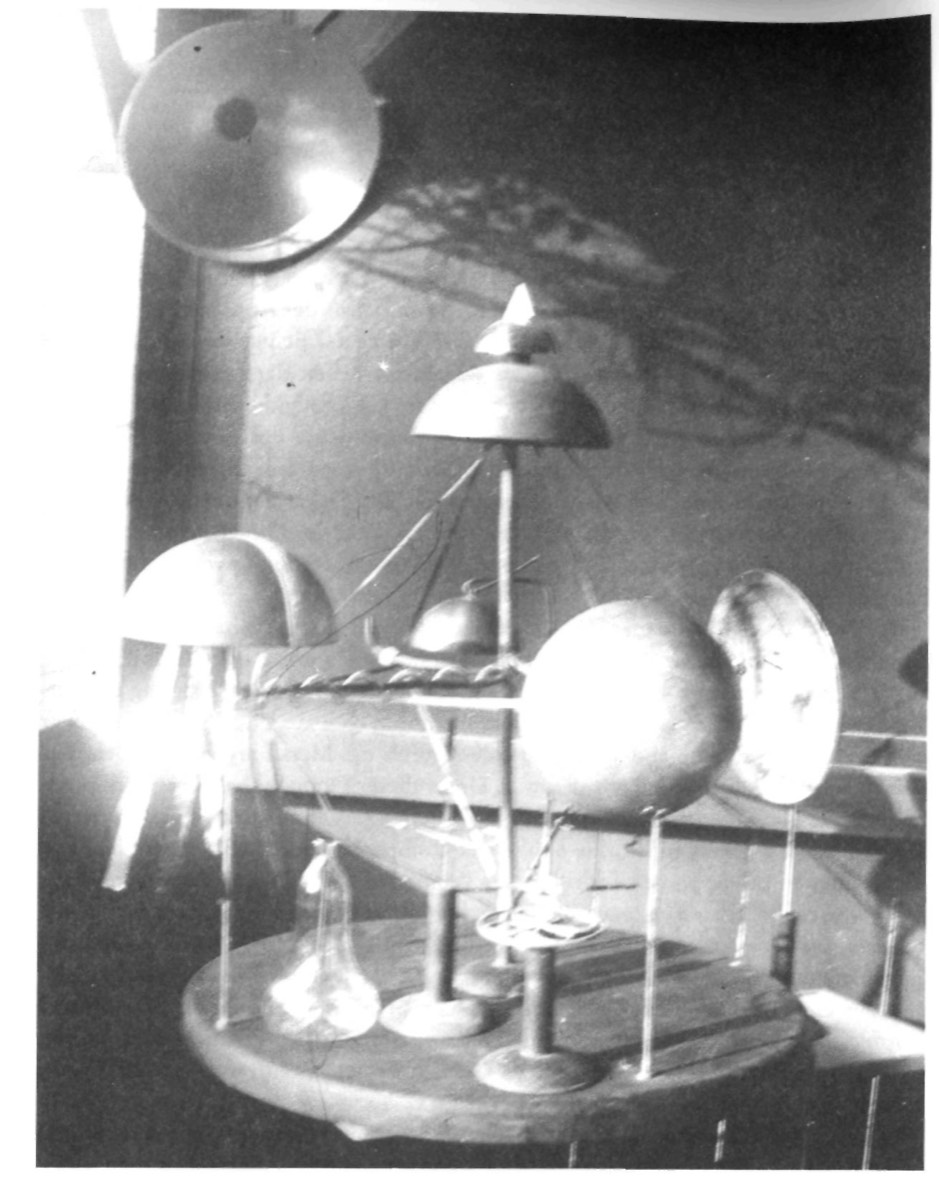
Rudolf Steiner — founder of anthroposophyAnthroposophy — the spiritual-scientific movement founded by Rudolf Steiner (1861–1925), from which Waldorf education and biodynamic agriculture also come. It carries the most disciplined and most developed esoteric literature on technology, which is why it anchors this site. — sketches a stage apparatus in 1912 for the inventor-character StraderStrader — an inventor in Steiner’s Mystery Dramas (1910–13). Steiner tied the character’s apparatus, by his own statement, to a future technology responsive to the human being — which made the stage models a century-long research obsession. in his Mystery Dramas. The primary documents, published by the Steiner estate in 1991, preserve the builder’s specification — including the instruction that electricity was to be kept out of it (“Elektrizität sollte abgehalten werden,” in the construction report of Hans Kühn).
The reading
Steiner’s war-years lectures state the thread’s future tense. From November 1917:
“The welding together of men with machines will be a great and important problem for the rest of earth-evolution.” Rudolf Steiner, lecture of 25 Nov 1917 (GA 178); translation as in G. Unger’s 1963 survey, corpus-verified
In the same breath the tradition disciplines itself: when Goetheanum researchers pressed toward etheric-technology experiments in 1920–21, Steiner judged the results premature and stopped the line — ripeness conditions again, applied this time from inside.
The radionics century Verified
The record
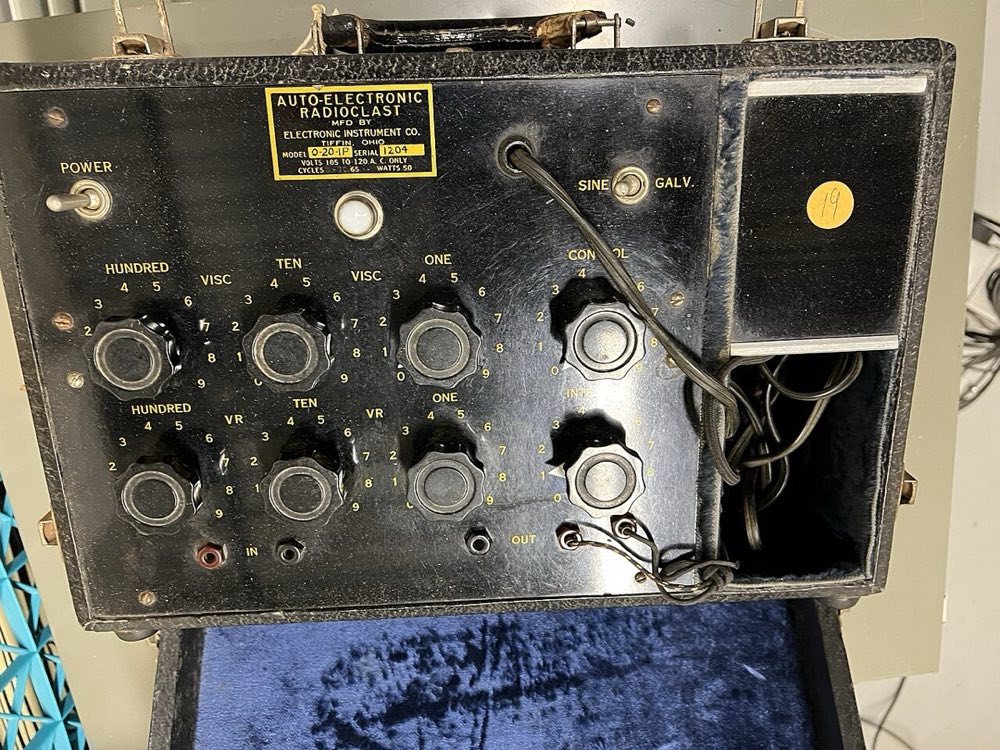
Albert Abrams’s diagnostic system requires a healthy human “subject” wired into the circuit — no human, no reading. Ruth Drown’s instrument is read through the operator’s finger on a rubber pad. Every independent investigation fails the instruments: Scientific American (1924), a British committee reporting in Nature (1925), the FDA (1951). At Drown’s trial, the prosecution’s expert dissects the device and states the thread’s claim exactly, from the debunking side:
“The only function performed by the patient was to complete the otherwise broken circuit.” Prosecution expert testimony, Drown case; reported in Ralph Lee Smith, “The Incredible Drown Case,” Today’s Health (1968)
The reading
Here the skeptics and the occultists converge on the same empirical fact — nothing works without the human — and diverge only on its meaning. One side says: therefore there is no instrument. The other says: therefore the human is the instrument. The disagreement is not about the data.
The patent and the ink drawing Verified
The record
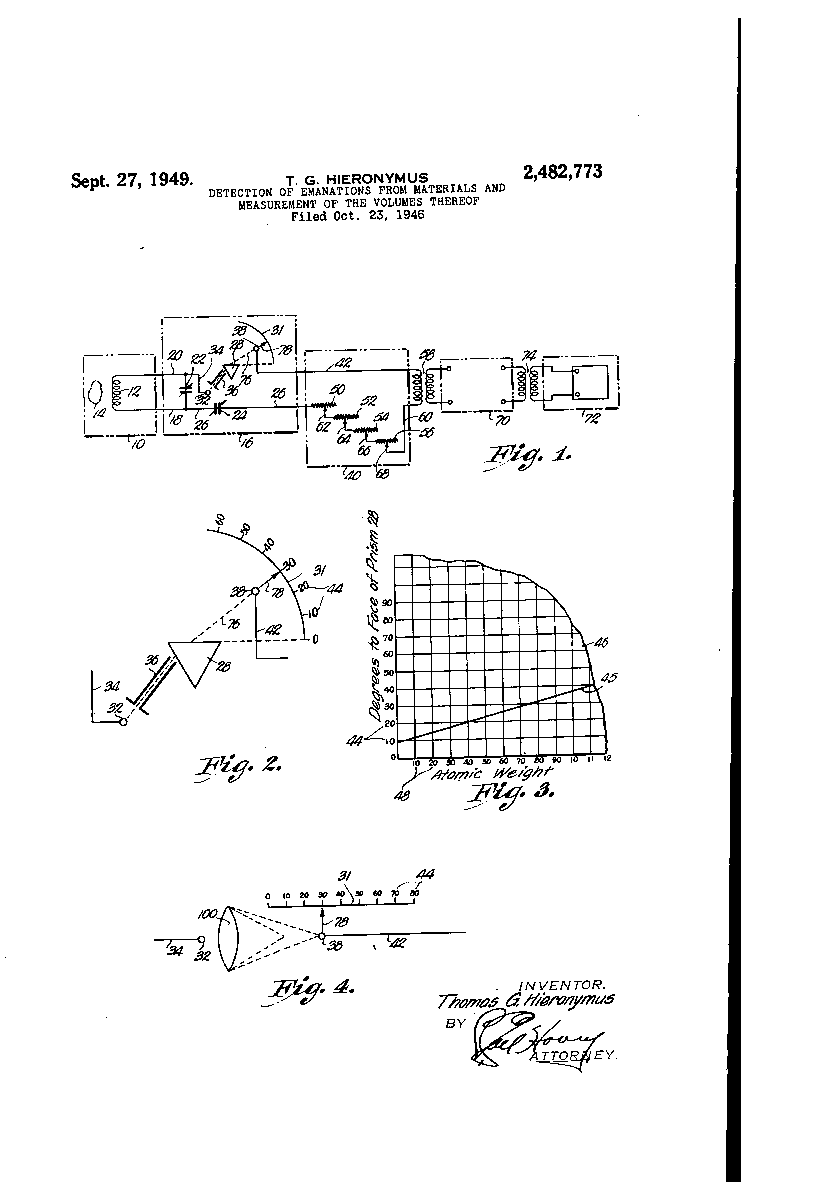
T. Galen Hieronymus is granted US Patent 2,482,773 (1949) for an instrument detecting “emanations” from materials — read by stroking a touch plate for a subtle stickiness under the operator’s fingers. John W. Campbell, the most influential editor in science fiction, promotes it in Astounding (1956) — then builds a version with no working components at all, the circuit merely drawn in India ink, and reports it works as well.
The reading
Campbell’s symbolic machine is the thread’s maximal statement: hardware fully dispensable, only the operator remains. And the century’s one dissent comes from inside — Hieronymus himself protested that Campbell had ruined him by putting the operator back in:
“…he set back the acceptance of my work at least a hundred years… The energy flowed over the lines of this drawing because India ink is conducting, but it isn’t worth a tinker’s damn for serious research or actual treating.” T. G. Hieronymus, The Story of Eloptic Energy (1988)
Operator-dependence wins in court Verified
The record
A purchaser of a Delawarr radionics instrument sues its Oxford maker for fraud. George de la Warr testifies — as reported in The Times — that the device “operated above the physical plane, and the box was only used as a focus for thought.” After some ten days in the High Court, judgment goes to de la Warr: sincere belief in an operator-dependent instrument is not fraud, whatever the judge thought of the box.
The reading
The claim is now sworn testimony, and it carries the day at law. Across the century, the doctrine that began as an occult teaching about purified attention has become a defense that wins because the instrument does nothing.
Philips v De la Warr, High Court, June–July 1960; case papers held at the Wellcome Collection.
Cybernetics reaches for the golem Verified
The record
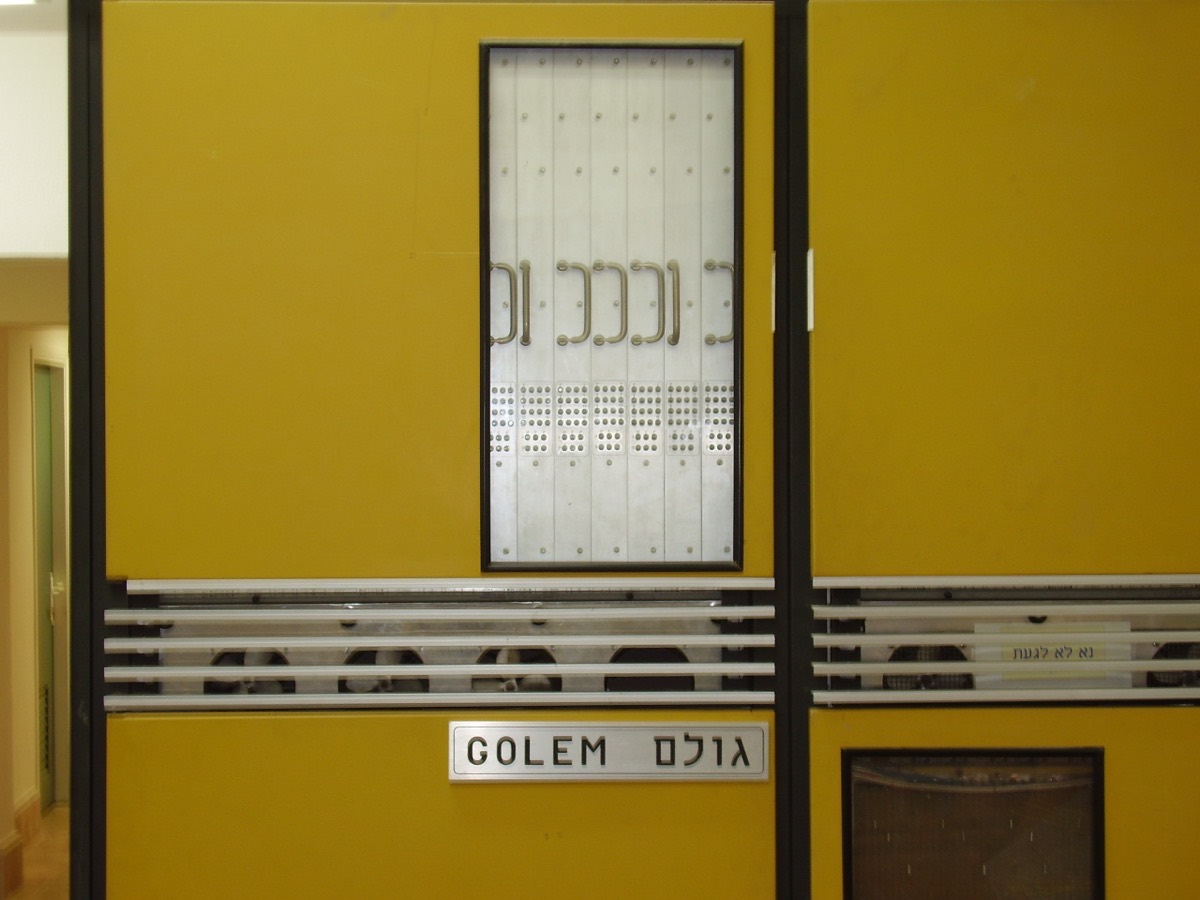
Norbert Wiener, founder of cyberneticsCybernetics — Wiener’s 1948 science of control and communication in animal and machine: feedback loops, self-correcting systems. The ancestor discipline of modern machine learning., closes his last book by naming the learning machine “the modern counterpart of the Golem of the Rabbi of Prague” — and argues that magic is the technically correct category for machines that do exactly what you asked and not what you meant: “the operation of magic is singularly literal-minded.” His portrait of the “gadget worshiper” describes the operator problem inverted — the human who wants out of the circuit:
“…the desire to avoid the personal responsibility for a dangerous or disastrous decision by placing the responsibility elsewhere: on chance, on human superiors and their policies which one cannot question, or on a mechanical device which one cannot fully understand but which has a presumed objectivity.” Norbert Wiener, God & Golem, Inc. (MIT Press, 1964) — open access; quote verified against the full text
The reading
The demonological reading of the machine is not imposed from outside by occultists — it arrives here from the founder of the machine’s own science, at MIT, in a National Book Award winner. The next year, Gershom Scholem — the century’s leading scholar of the golem tradition — dedicates Israel’s new computer under the name Golem Aleph, with a blessing: develop peacefully, and don’t destroy the world.
The circuit without an operator Interpretive
The record
The large language modelsLarge language model (LLM) — a system trained on enormous quantities of human text to continue text plausibly. The trained model is then shaped toward helpfulness by further training. It runs identically for any user, anywhere — no special operator required. of the 2020s are, in engineering fact, the perfected opposite of everything above: instruments that work for everyone, identically, at scale — circuits from which the operator has been removed by design. And the era describes its own machines in the stream’s old vocabulary: a founder-engineer warns of “summoning the demon” (2014, verbatim on record); the field’s own popular image for a trained model is a masked shoggothShoggoth — a shapeless monster from H. P. Lovecraft’s fiction (1936). Since late 2022, the tech world’s own joke-image for a language model: a vast alien mass wearing a small smiley-face mask, the mask being the training that makes it helpful.; the training step called RLHFRLHF — reinforcement learning from human feedback: human raters score the model’s outputs, and the model is adjusted toward what they approve. It is the step that turns a raw text-predictor into a usable assistant — the “smiley face” in the field’s shoggoth image. is the smiley face drawn on it.
The reading
The tradition spent five centuries insisting that the lawful instrument includes the operator’s own moral organization — and its picture of the other kind of machine was always precisely this: the circuit that runs without anyone in it. Whether that is prophecy, coincidence, or a question, it is the question this history puts to the machines of the present — and to the laboratories now writing constitutions and training values into them, which are, on this thread’s terms, attempting to re-enter the circuit from above.